From the first AfriFlux Space, 25 November 2026, with Seun Lanlege, co-founder of Polytope Labs. Quotes are lightly edited for clarity.
Hyper FX lets you swap one stablecoin for another on chain. You can turn USDC into cNGN, or cNGN into USDC, without giving your money to an exchange to hold. This year its users hit a simple problem. They swapped into cNGN, and then they wanted naira in their bank account.
"Our customers don't just want to swap to cNGN," Seun Lanlege told our first monthly Space. "They want naira in their bank accounts."
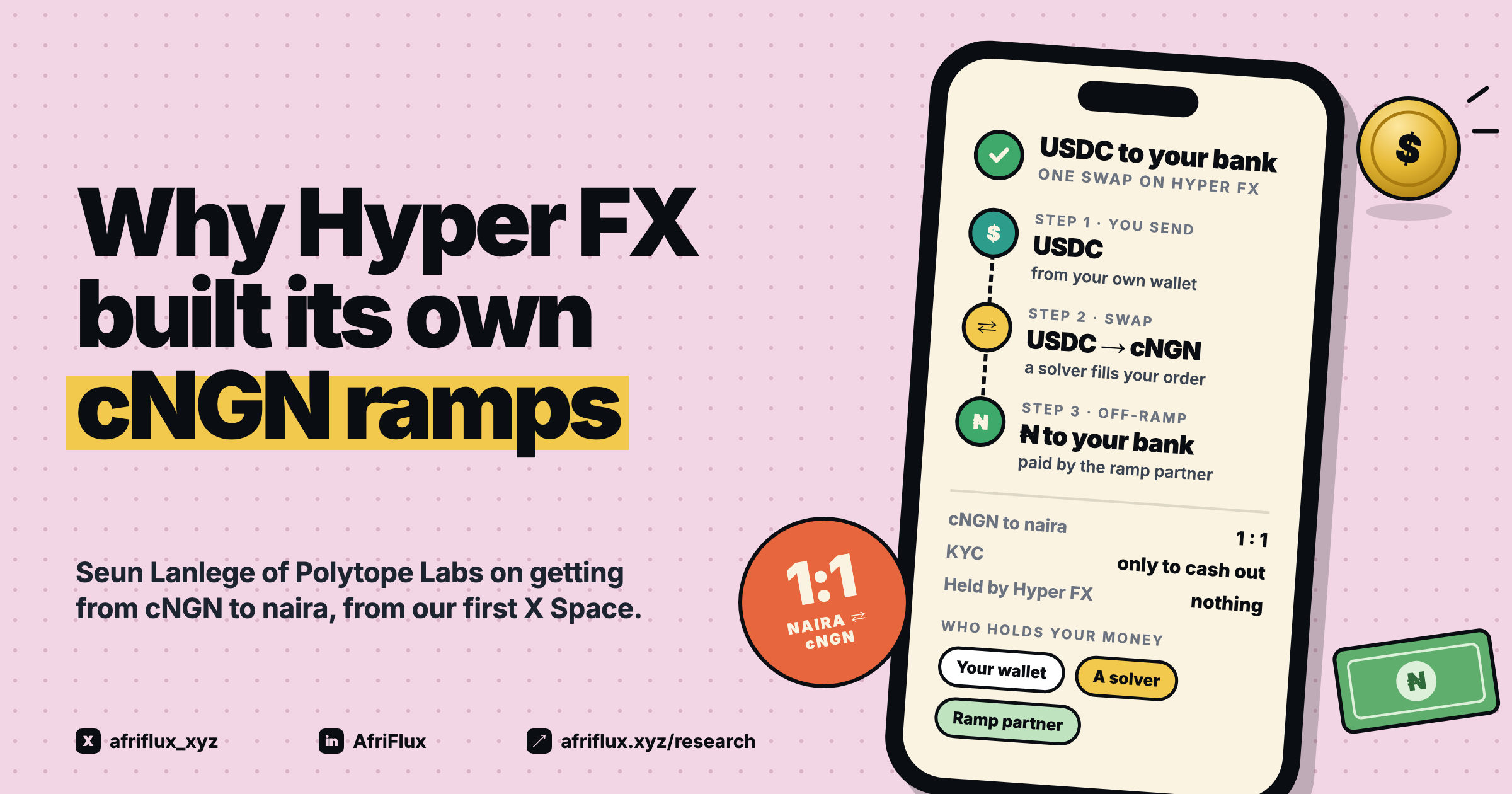
So Hyper FX built its own ramps. A ramp connects a stablecoin to money in a bank. An on-ramp takes your naira in and gives you coins. An off-ramp takes your coins and pays naira out.
Seun co-founded Polytope Labs, the team behind Hyperbridge and Hyper FX. Over an hour, he explained why they built ramps they never wanted to build. He also covered where on-chain FX fits in Nigeria, why one naira stablecoin is not enough, and what banks will do next.
What Hyper FX does
Polytope Labs first built Hyperbridge. It lets a stablecoin issuer put the same coin on many blockchains, so the coin can reach the users on each one. Hyper FX came this year and runs on top of it. It swaps between stablecoins in different currencies, on different chains. Seun calls the category "on-chain FX".
The goldmine is the exchange rate
Seun's case starts with tokenization, which means putting shares, bonds and other assets on a blockchain. Each of those assets needs a currency to trade against. When the Dangote IPO went on chain through NectarFi and GetEquity, it was priced in cNGN, not USDC. A Nigerian in the US who wants those shares holds dollars, so something on chain has to change one into the other.
"Everyone is going after the tokenization of the assets themselves. But the FX infrastructure that will bring the world together is the real goldmine."
Mukhtar, AfriFlux's co-founder, pushed back. Only about $3 million of Dangote shares were bought on chain, and most Nigerians bought through apps like Bamboo. Why would they move?
Seun said they mostly won't, and that isn't the point.
"Tokenization is not a function for the people who are inside of the financial ecosystem. The people who use USDT the most are not in the US. It's the rest of the world."
He said the buyers are abroad. Family offices in Dubai, Europe and the US already hold dollar stablecoins, and Nigeria pays a yield few markets can match.
"Nigeria has one of the highest treasury yields, around 20-something percent. No one else in the world is giving that."
Local buyers gain something too. "You could buy your Dangote stocks on Bamboo," he said, "but you can't loan against those stocks on Bamboo." On Base, people already borrow against tokenized NVIDIA shares through lending apps like Aave and Morpho.
He said the banks are already moving. "Banks really want tokenization specifically so they can sell tokenized assets to the rest of the world." He expects a few Nigerian banks to launch tokenized versions of listed stocks before the end of 2027.
"cNGN is not designed to be very liquid"
This is where ramps come in. Getting naira back from cNGN's issuer is not simple, and Seun was blunt about it.
"cNGN is not designed to be very liquid."
So Hyper FX users who ended up holding cNGN sent it to fintech apps that would pay them naira. AfriFlux data showed much of it went to Azza, a WhatsApp off-ramp. Seun put that at over a billion naira, with Noblocks second.
It didn't last. Azza's founder, Tochukwu, raised it with Seun. "He was complaining that our users are exhausting his naira," Seun said. Users waited days to get paid. Azza started charging fees, because it also struggled to turn cNGN back into naira. Another fintech's founder told Seun that Hyper FX users had sent it almost half a billion naira in cNGN, and it didn't know what to do with it.
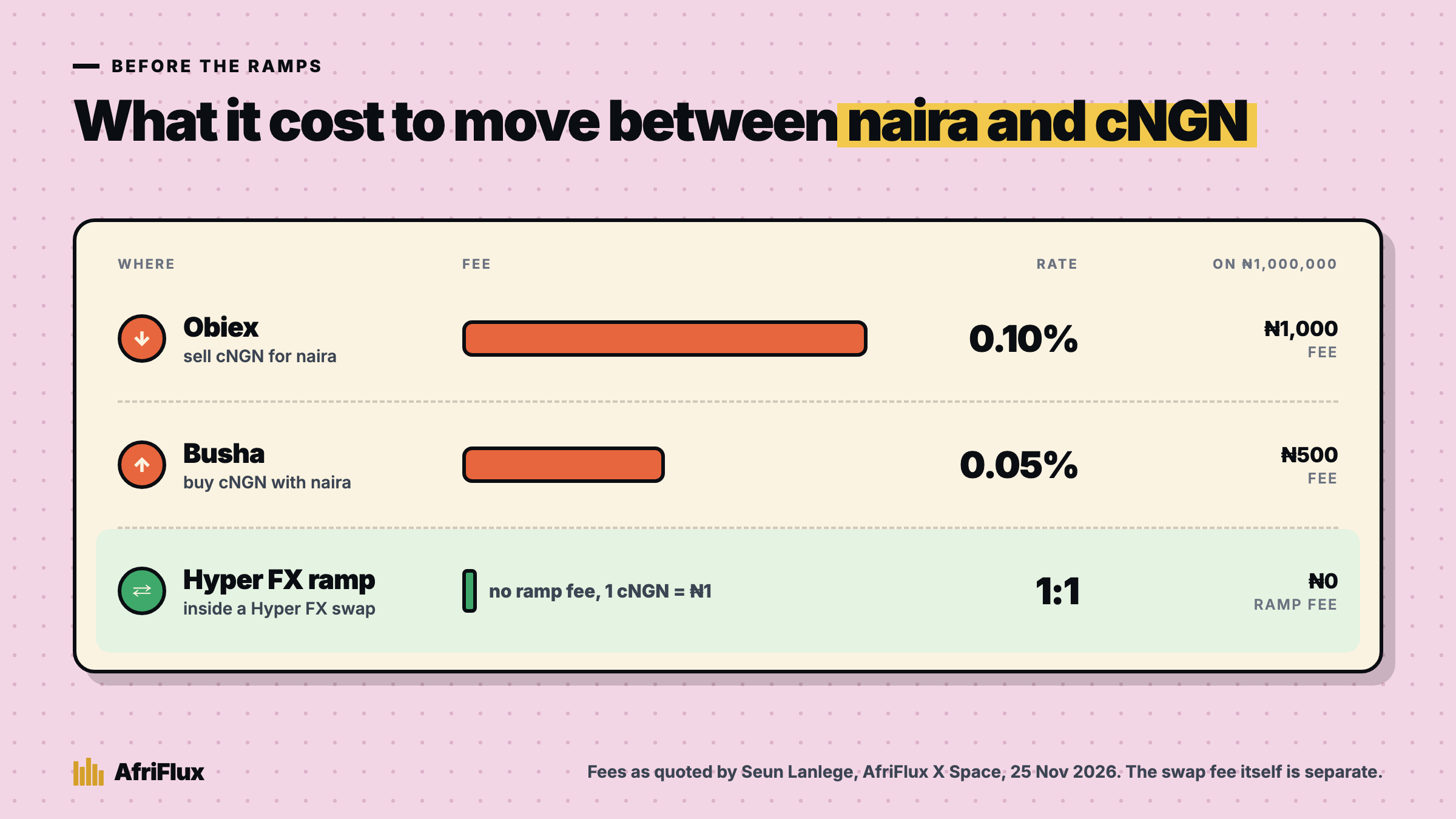
The other choices cost money. Seun said Obiex charges about 0.10% to sell cNGN for naira, and Busha about 0.05% to buy it. A user pays that on top of Hyper FX's own fee.
"We didn't want to have to do ramps."
He said it more than once, and then explained why they did it anyway.
"Sometimes in business, there's what you want and there's what the market wants. It takes a lot of humbling to give up what you want and do what the market wants."
Or, more briefly: "We don't complain. We build solutions."
How the ramps work
Hyper FX doesn't run the ramps itself. Busha runs the on-ramp and Staybl runs the off-ramp. The contracts set how much liquidity each must keep ready and how reliable the service must be.
- Plain swaps need no KYC. If you only want to swap, Hyper FX stays a DeFi app.
- Naira in your bank needs KYC. Hyper FX passes your details to the partners and doesn't keep them.
- On-ramp: Busha opens an account for each user. You send naira to it, and your wallet gets cNGN.
- Off-ramp: in the same swap, your coins go to the partner's address, and the partner pays naira into your bank.
- The rate is 1:1, naira to cNGN and back, but only as part of a Hyper FX swap. If you bring cNGN only to cash it out, you pay a fee.
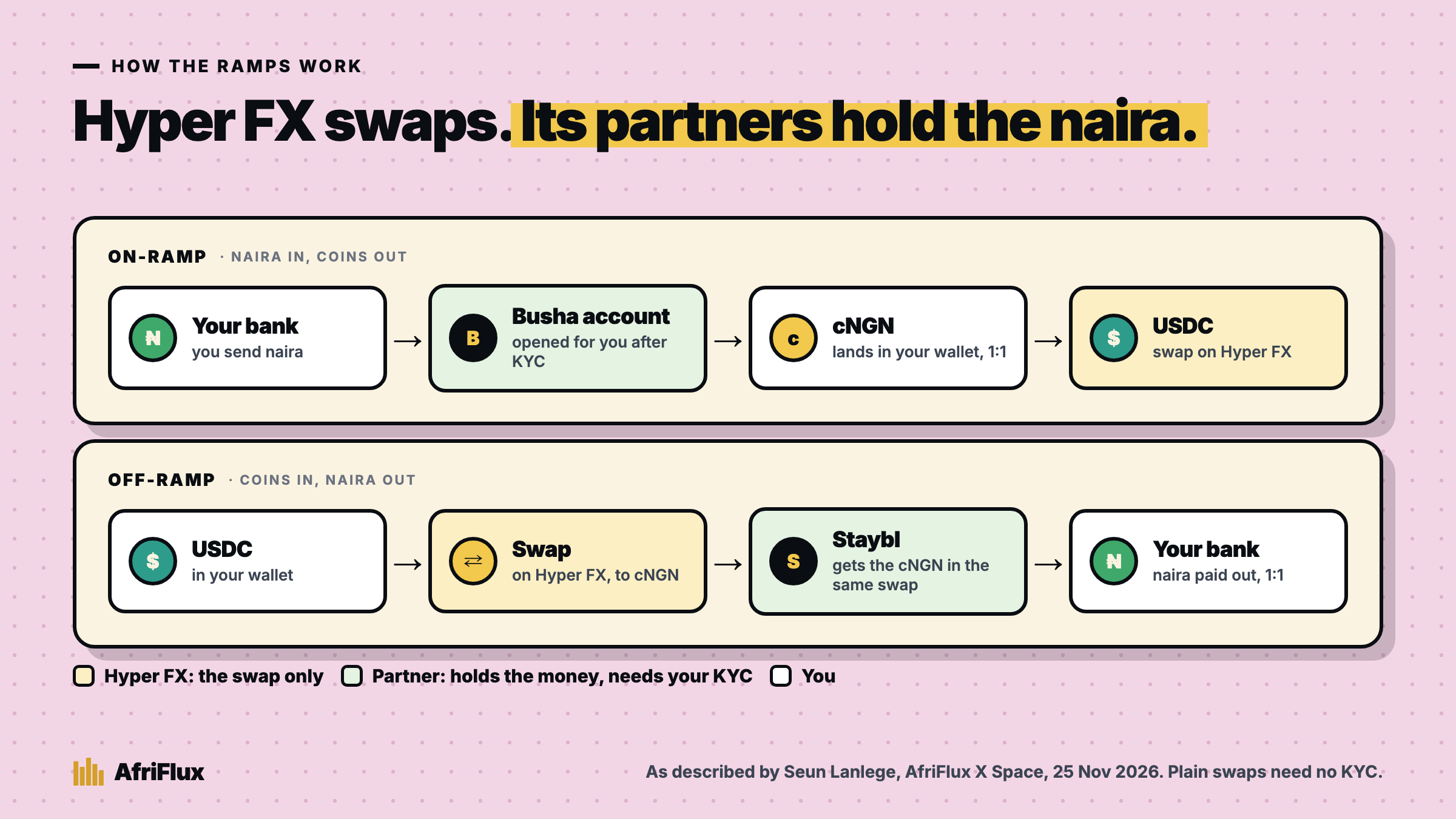
Hyper FX never holds customer money. Its partners do.
The ramps aren't a business line. "We're not really trying to be a Breet or a Spenda," Seun said. "We see these people, in fact, as our customers."
A hot patch until banks issue naira coins
Seun doesn't expect the ramps to last forever.
"We recently launched ramps for cNGN, but to me, that's a temporary measure. It's like a hot patch."
New rules let commercial banks issue stablecoins, and he thinks the first bank to do it will gain the most. "The first commercial bank to issue a stablecoin is going to reap the rewards." In his ideal setup, you send naira coins back to your bank app and they show up as naira you can spend.
He thinks bank coins will also change what a fintech app is.
"DeFi protocols are essentially applications of money."
An app could ask for permission to spend your coins, just as a phone app asks to use your camera. That permission is called an approval, and you set the limit. A savings app could take a fixed sum on the first of each month and never more.
"We never really cracked direct debits in Nigeria, but stablecoins would enable that."
He doesn't expect banks to hold dollar stablecoins. The CBN limits the dollar assets a bank can hold and watches those balances closely.
"If banks are holding dollar stablecoins, then this immediately falls out of the oversight of the CBN."
"They want monetary control over FX," he said. So banks will keep dollars in domiciliary accounts and issue naira coins.
Why Nigeria needs more than one naira coin
Seun has tweeted that Nigeria needs more naira stablecoins. His example is USDT and USDC. For years it was hard to move between dollars and USDT. Circle then made USDC easy to get in and out of, and USDT had to catch up.
"If we only have one stablecoin, then we're all just going to be at the mercy of their own discretion."
He thinks competition will fix the cash-out problem first.
"This whole liquidity issue with stablecoins will be one of the first things that get fixed when there's competition."
He pointed to Busha's line for its own coin, "1 NGNB = 1 NGN". He called it "a direct shot across the bow to cNGN", which trades at about 0.995 naira in some places.
Hyper FX itself won't pick a winner. Seun compared it to Uniswap, where any coin can trade. It is already talking to South African issuers, including ZARP and Luno.
"We're not here to crown which stablecoin is the best."
Mukhtar pointed out that cNGN carries about 99% of local stablecoin volume in our data. Seun said issuers in other countries face tougher rules.
"Regulation is great, but at the same time, innovation is what moves the economy forward."
Has cNGN found its market?
Seun said yes, through on-chain FX, with a catch.
"I think it has, with on-chain FX. Even though I don't know if they want the PMF."
He said the issuer wants to earn yield on its reserves, which works best when coins stay put. Coins that move freely are what on-chain FX needs. PMF is short for product-market fit.
A listener who said he had worked at cNGN agreed that 90–95% of volume in his time came from on-chain FX and remittances. He said the next step is local transfers, and pointed to work with Interswitch and NIBSS.
Africa never built its own switch
Europe has SEPA and North America has ACH. Seun said Africa never built its own system for moving money between countries.
"Africa has yet to build out its own monetary switching system."
He noted that PAPSS exists, but called it an isolated network. He expects stablecoins to fill the gap.
"Stablecoin FX will be the settlement rail for cross-border trade within Africa. It's just a matter of time."
He doesn't see one African currency or coin working. Economies at different stages need different monetary policy, and one policy for all would tie everyone to the same pace. "Everybody else moves at the rate of the slowest." He thinks pairs will form from trade instead. If Nigeria trades a lot with Ghana, a naira–cedi pool forms.
The listener disagreed. He said African central banks don't talk to each other, so naira-to-cedi rates still go through the dollar. He described a single African reference coin backed by PAPSS, Afreximbank and Interstellar, with each local coin paired against it. He said it is live, but its beta is waiting on central banks.
Nothing to hack
Hyperbridge had a security incident earlier this year. Seun said it taught them where the real risk sits.
"Smart contracts that hold money permanently are the perfect targets for attackers."
Hyper FX is built so its contract almost never holds anything:
- You lock your coins with a deadline, such as five minutes, and the lowest rate you'll take.
- Liquidity providers, called solvers, send offers.
- You pick one, and both sides swap in a single transaction.
- If no offer comes, you get a refund.
There is no liquidity pool. Solvers keep their money in their own wallets and only bring it when a swap runs.
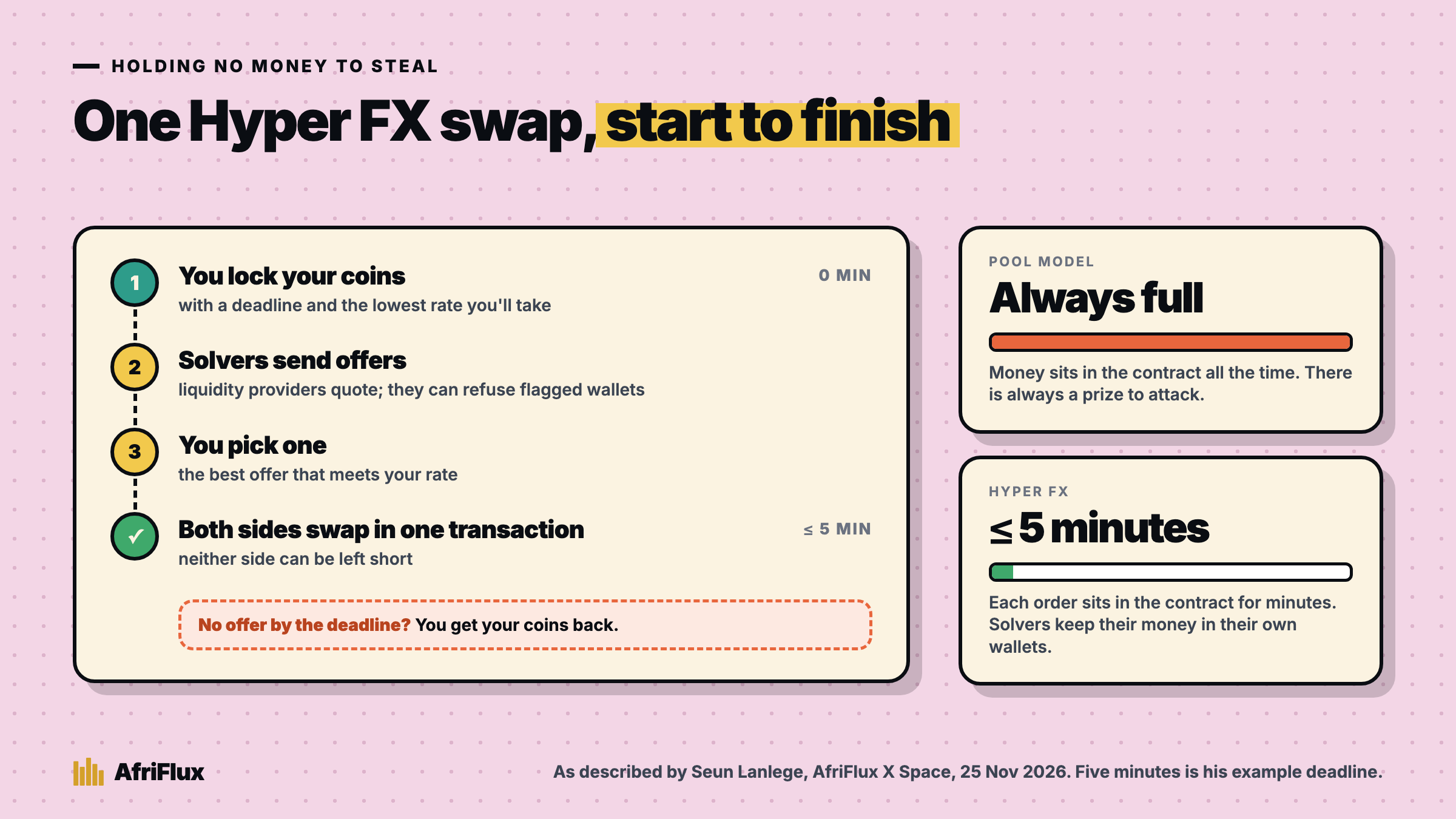
"At any given moment, there's literally nothing that the smart contracts are holding. So there's nothing for anybody to hack."
The contracts are on HackenProof, a public bug-bounty site. Seun said they have paid security researchers over $200,000 there. He wasn't shy about the rest of the industry either: "If these protocols haven't had a security incident, then I think it's only a matter of time."
What success looks like in 2027
Seun wants Hyper FX to be the deepest place for on-chain FX liquidity. He compares it to MetaMask. A self-custody wallet doesn't hold the coins you swap. It sends the swap to on-chain venues and takes a fee. He put MetaMask's swap revenue last year at about $300 million.
"MetaMask doesn't own liquidity, but they make money off of it."
Fintech apps work the other way. To swap USDC for naira, an app has to hold a large pile of naira, called float. If your swap is bigger than the float, you wait or get a refund.
"It doesn't really make sense that fintechs are competing on how much liquidity they have. Liquidity should become commoditized."
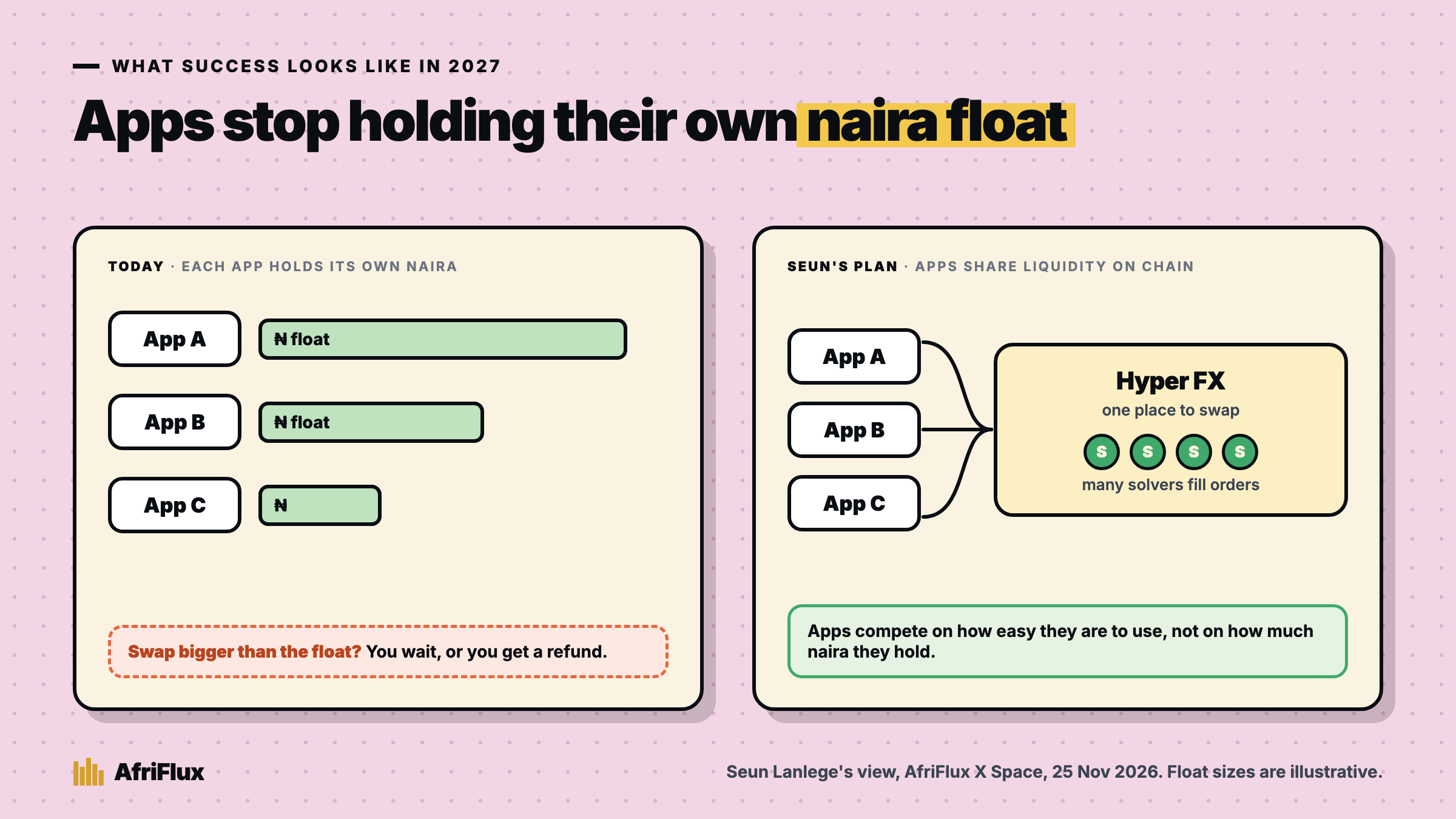
For him, success is the point where apps stop holding float and use Hyper FX whenever their users need to swap. "No one should have to turn away customers because they don't have the liquidity."
Our next Space is planned for mid-December.