In the 1980s, a trader who wanted a bond price, the news behind it and the history of the issuer had to make three phone calls and dig through a filing cabinet. The Bloomberg Terminal put all of it on one screen. Each piece of data was more useful because the rest sat next to it.
African stablecoin markets are where bonds were before Bloomberg. The money moves through exchanges, P2P desks, neobanks, payout apps and business payment rails. Each company sees its own books. An exchange that wants to know whether it gained ground on a rival last quarter has nowhere to look. Neither does a payments app that wants to know where its depositors also keep money.
We built the AfriFlux Terminal to be that one screen.
How much is still ahead
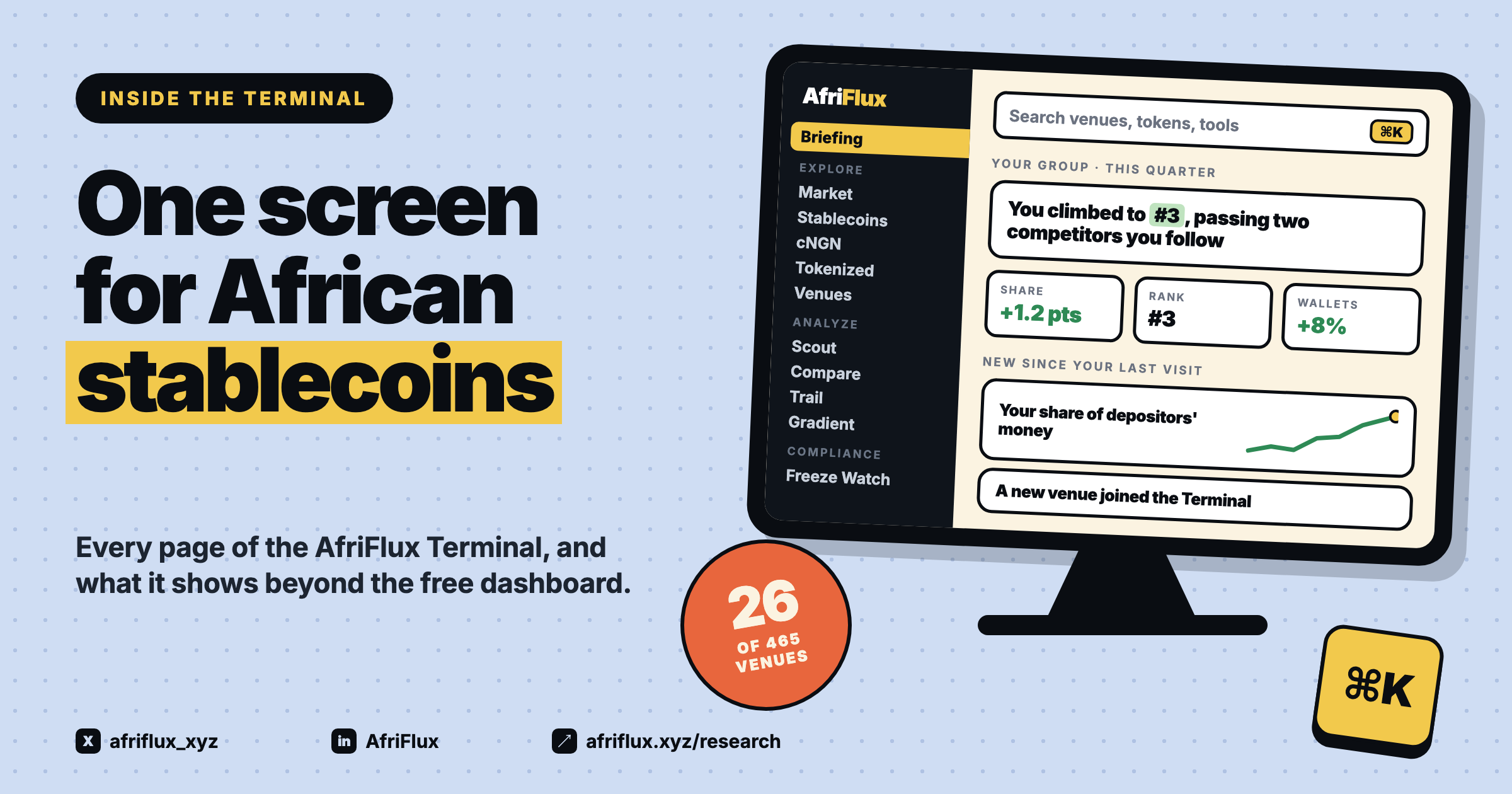
Stablescape counts 465 stablecoin venues operating across Africa. AfriFlux measures 26 of them today, in Nigeria and South Africa. We also track four infrastructure providers (Paycrest, Hyper FX, Textile FX and Blockradar). On top of that, we track the tokenized stocks, ETFs, metals and pre-IPO shares that African apps sell onchain: about 260 assets, from 12 issuers, sold through eight apps.
That is around 5% of the venues out there, so there is a lot of room to grow. Even so, the data is already deep. For every venue we track, we have every deposit and withdrawal, every chain and token, and every depositor wallet, quarter by quarter, going back to 2021 for the oldest. Each new venue we add improves every page below, because almost every page compares venues with one another.
Who uses it
Daya Pro, Spenda, Raenest and Hyper FX use the Terminal for market intelligence. They follow their own numbers, keep an eye on competitors, and check where the market is moving before they make a call. The venue pages and the daily Briefing are the parts they come back to most.
The public dashboard and the Terminal
The public AfriFlux site is free and will stay free. It covers the same venues and the same market, and it is a good place to see what is happening.
The Terminal goes further in two ways:
- More data on every page. Wherever the public site shows a total, the Terminal shows what is behind it: who the money came from, where it went, which wallets came back, and which addresses hold it.
- New data arrives in the Terminal first. Every new venue starts in the Terminal and reaches the public site later. VALR and Luno were in the Terminal on 3 October and public on 5 October. Divest was in the Terminal on 7 October and public on 9 October. Hisa was in the Terminal on 10 October and public on 12 October.
Here is each page in turn. The screenshots are from the live Terminal, taken between 1 and 5 November 2026.
Briefing
This is the first thing you see when you open the Terminal. It's a short read about your own company. At the top is how you did against the competitors you follow: whether you moved up or down, and who you passed. Below that is what changed since your last visit, followed by anything new in the market, such as a venue that just joined our coverage.
It stays short on purpose. Once you have read everything, it tells you so. You don't see the same item two days in a row.
Infrastructure companies get the same Briefing about their own rail: how this week compares with a usual week, big days, failed orders, record months, and the corridors their money runs on.
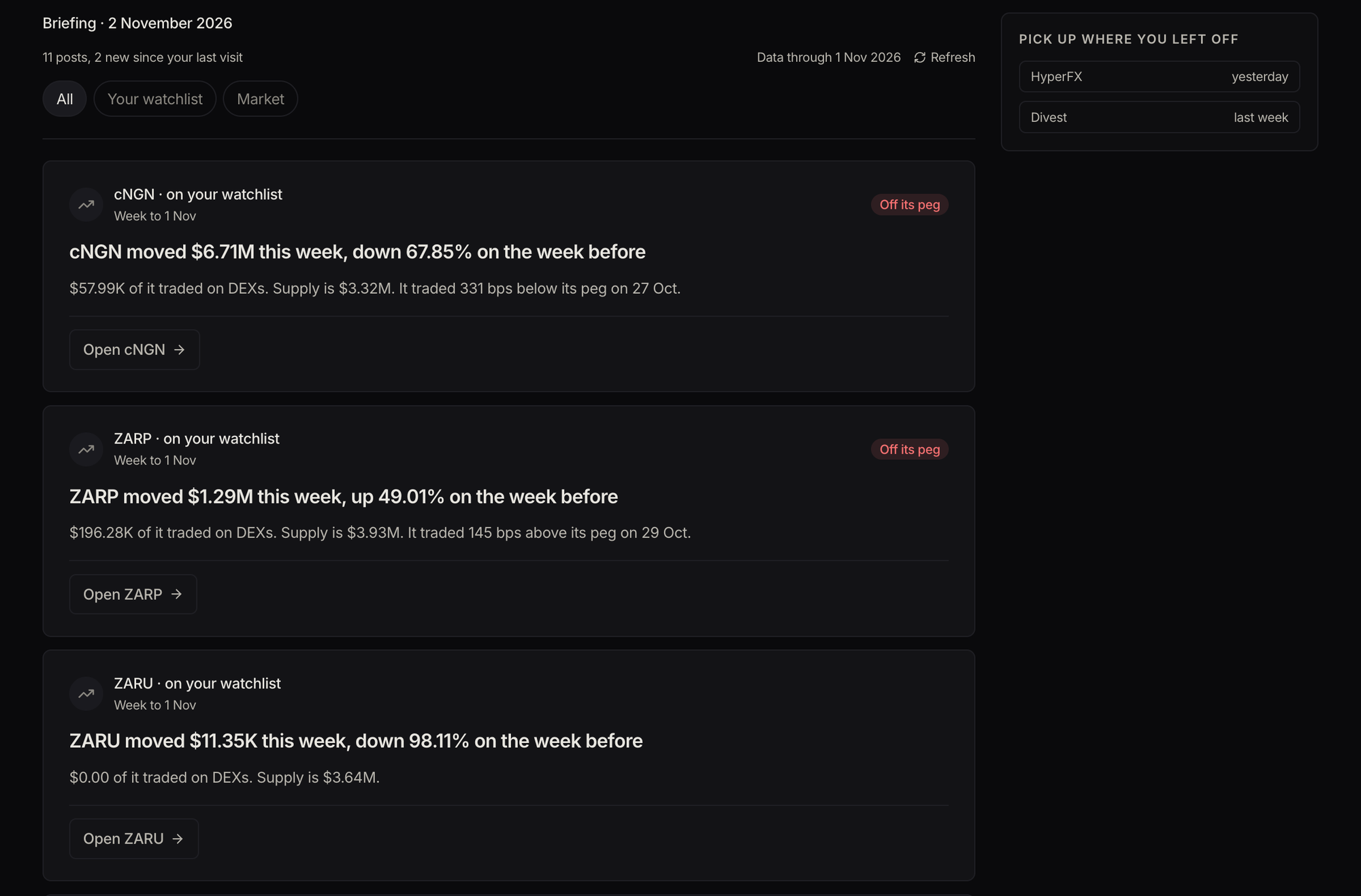
Public version: none. The public site shows everyone the same market. The Briefing is about your company.
Search
Press ⌘K anywhere and type a venue, a token, a category or the name of a tool. It works like typing a ticker on a Bloomberg keyboard: you get there without clicking through menus.
Public version: the public site has search too, but it only finds public pages. In the Terminal it also finds tools, your saved screens and venues that haven't gone public yet.
Market
The whole picture in one place: total stablecoin volume across our venues, how it splits between tokens and chains, where the money was funded from, and how this quarter compares with the last.
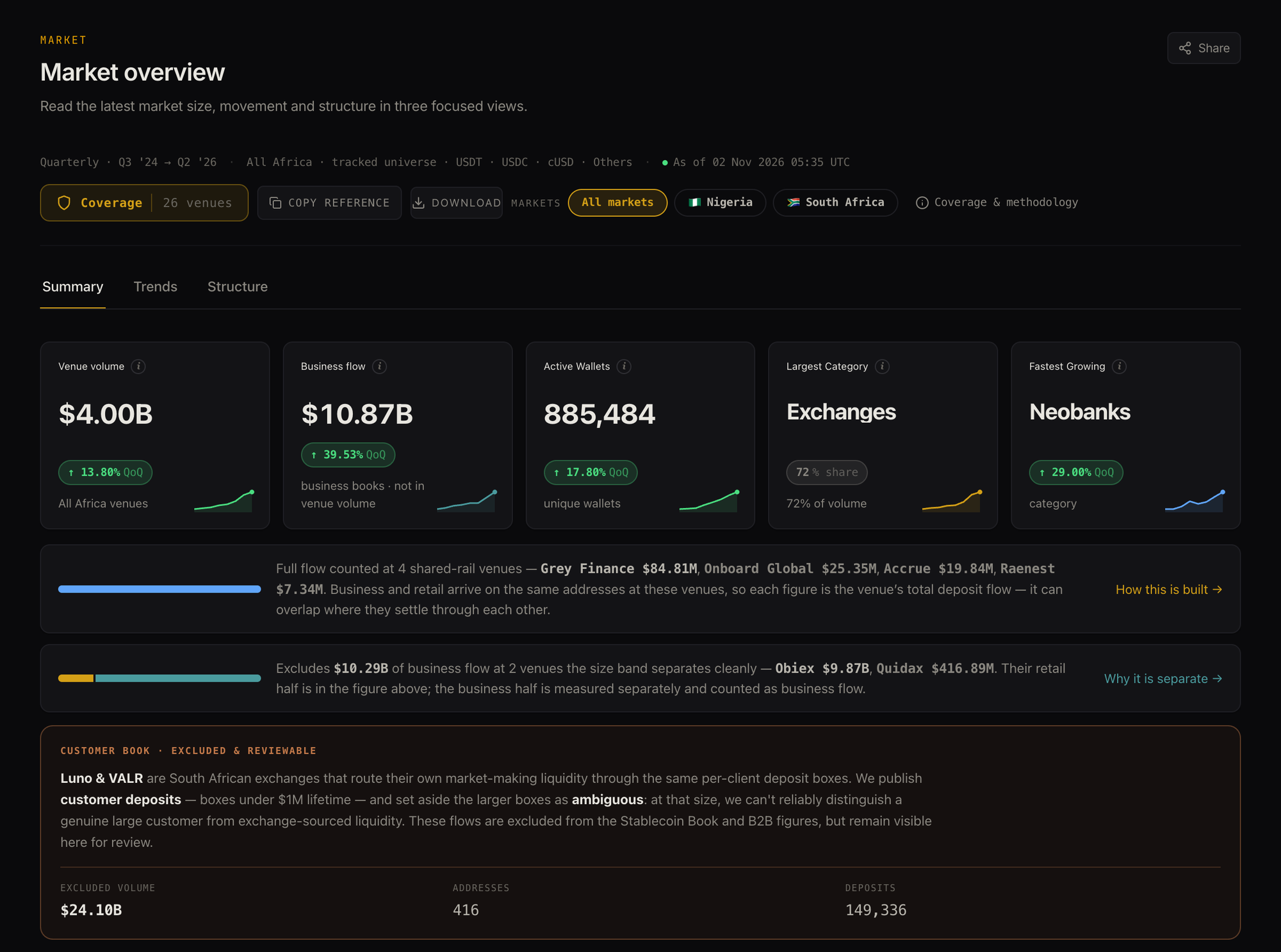
Public version: the same page with the same layout. The Terminal version includes venues that haven't reached the public site yet, and you can export any table.
Stablecoins
Every stablecoin that moves through African venues, with adoption, flows and pricing, plus a page for each native African stablecoin.
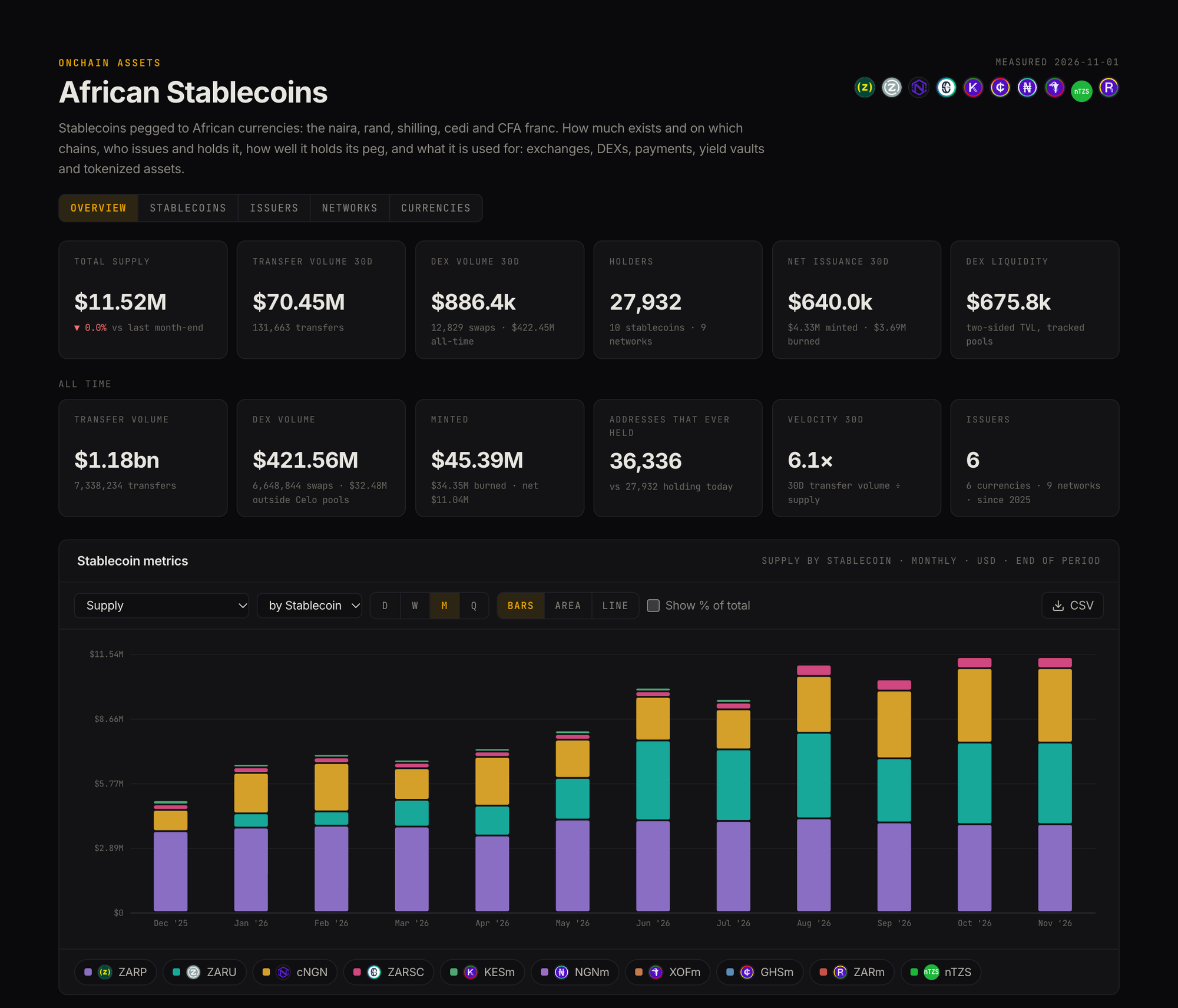
Public version: the same token pages. Inside the Terminal, these pages lead into the issuer views, starting with cNGN.
cNGN
This is the most complete view of a single stablecoin anywhere. For cNGN, the digital naira, the public site shows supply, holders, transfer and DEX volume, the peg, and contracts on each network. The Terminal shows who is behind each of those numbers, across eight chains and more than 23,000 addresses.
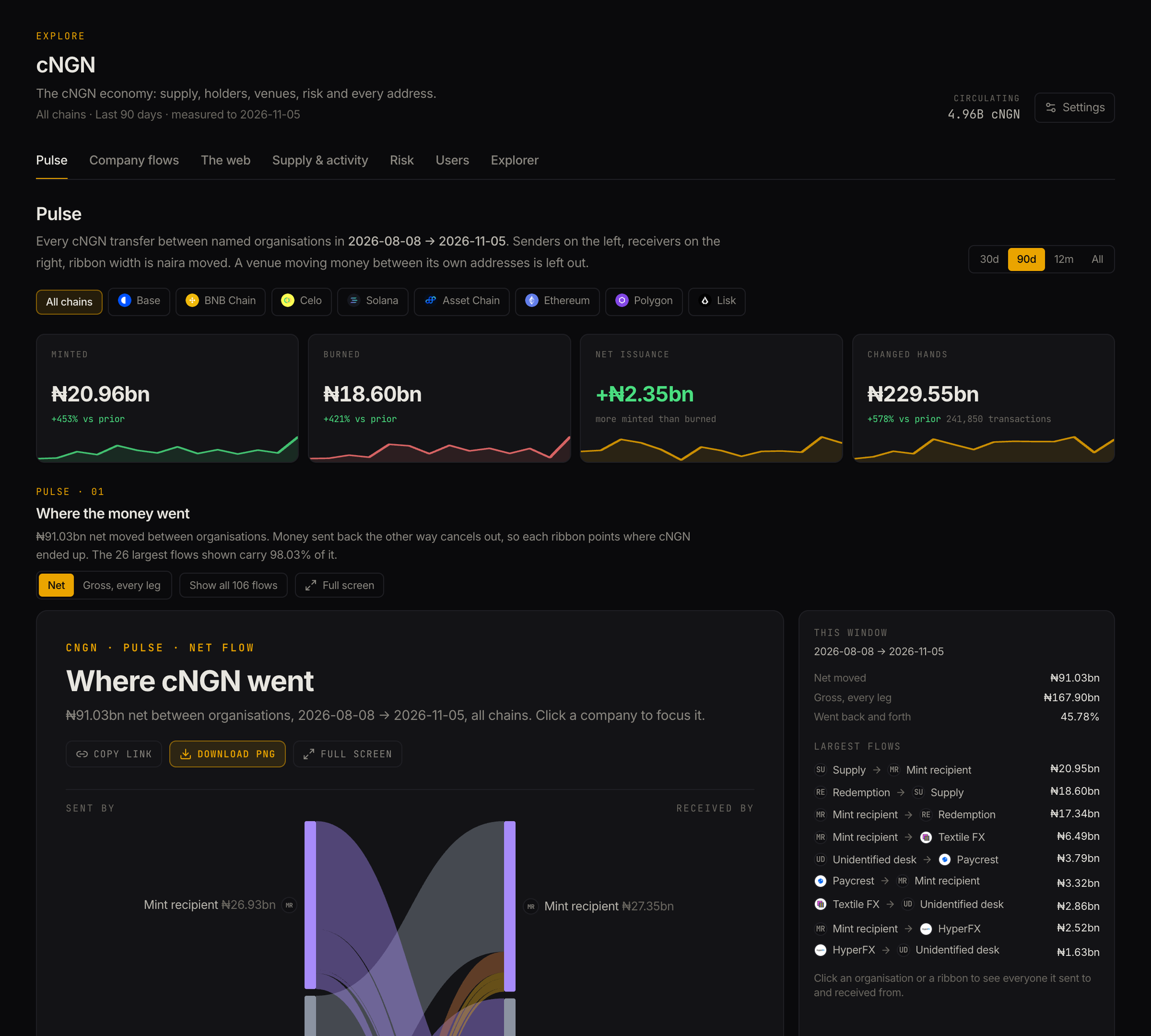
It has seven views:
- Pulse: what moved today. Where the money went between organisations, who sent and who received, and who holds cNGN right now. You can choose any date range and compare it with the period before.
- Company flows: every organisation that moves cNGN, ranked. Open any one to see who it sends naira to, who sends it naira, and how money moves between its own wallets. For exchanges and apps, it also shows where customer deposits came from and where they went next.
- The web: a map of who moves cNGN to whom. It shows the exchanges, apps, markets and unidentified wallets the token depends on, and how much moves along each link. You can search for any company on the map.
- Supply and activity: cNGN created and destroyed on each chain, how much is in circulation, and how often each naira changes hands.
- Risk: how concentrated the holdings are, how much is being redeemed, how much sits unused, and the routes people take out.
- Users: how many wallets and venue accounts hold cNGN, whether they come back, how they first got it, and how much they move.
- Explorer: search any address that has ever held cNGN. You get its balance over time, everyone it dealt with, the venues and organisations it touched, and every transfer, each linked to the transaction on its chain. You can switch between money in and money out. Forty deposit addresses at one exchange show up as one relationship.
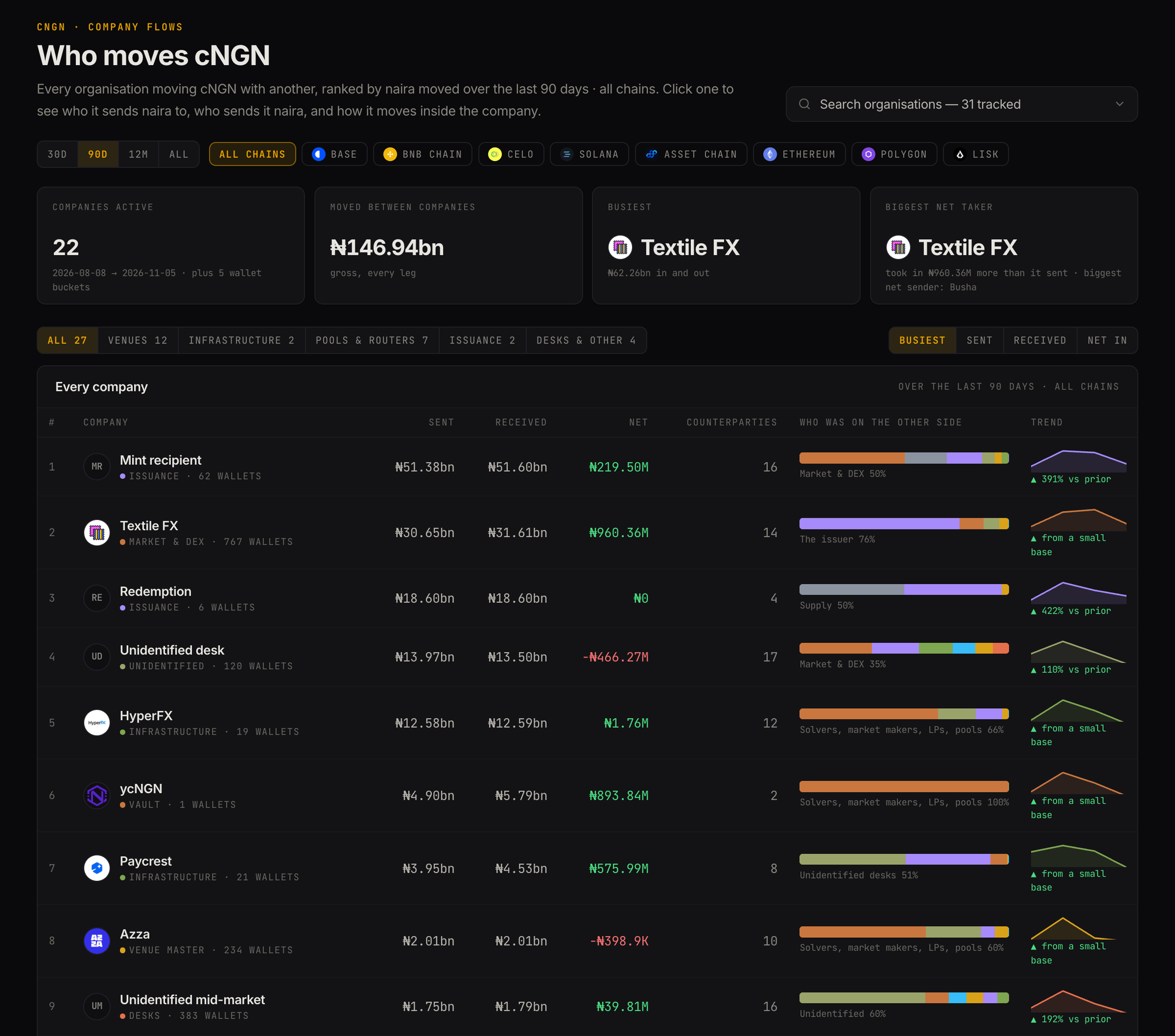
Every view can be shared. Download it as an image, copy a link that opens the same view, or export the data as a CSV.
You can also set alerts for the moments that matter to an issuer:
- a large amount created or destroyed in one day
- one holder going above a set share of supply
- a venue's deposits jumping from one week to the next
- redemptions building up on a chain
This is the view an issuer needs to manage its token, an exchange needs before it lists one, and a treasury team needs before it holds one. We built it with the cNGN team, and every African stablecoin we add next gets the same seven views.
Categories
Exchanges, P2P and payout desks, neobanks, savings and investment apps, and business payments. Each category ranks its venues and shows how the category as a whole is changing.
Public version: the same rankings. The Terminal adds datasets for organisations only, and shows where your venue stands against the rest of its category.
Venues
Each venue has a dossier with four tabs (Overview, Flows, Composition and Risk) and a line at the top saying what changed.
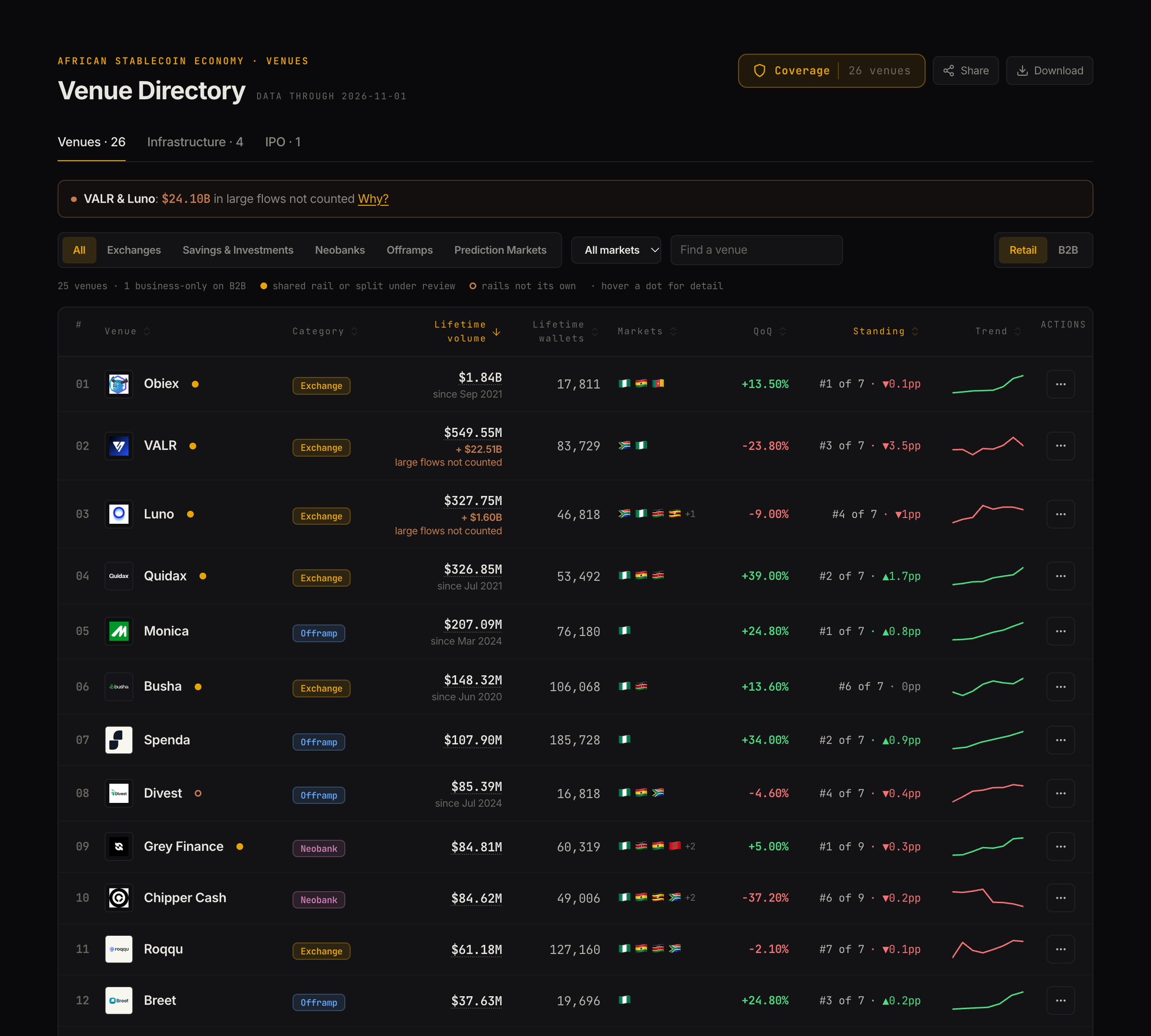
Public version: the same venues, the same tabs and the same headline numbers. The Terminal fills in what the public page leaves out:
- Where the money comes from and goes to: the exchanges and organisations on the other side of each venue's flows, plus a map of how money moves through it
- Chains: the full list of chains a venue runs on and how its volume is spread across them (the public page shows only the count)
- Depositors: what kind of depositors it has, how big their deposits are, and how many come back
- Standing: rank in the market, change in market share, and size against its category
- Business book: for venues that serve both retail customers and businesses, the business side measured separately
- Competitors: how you compare with the venues you follow, set up once for your whole team
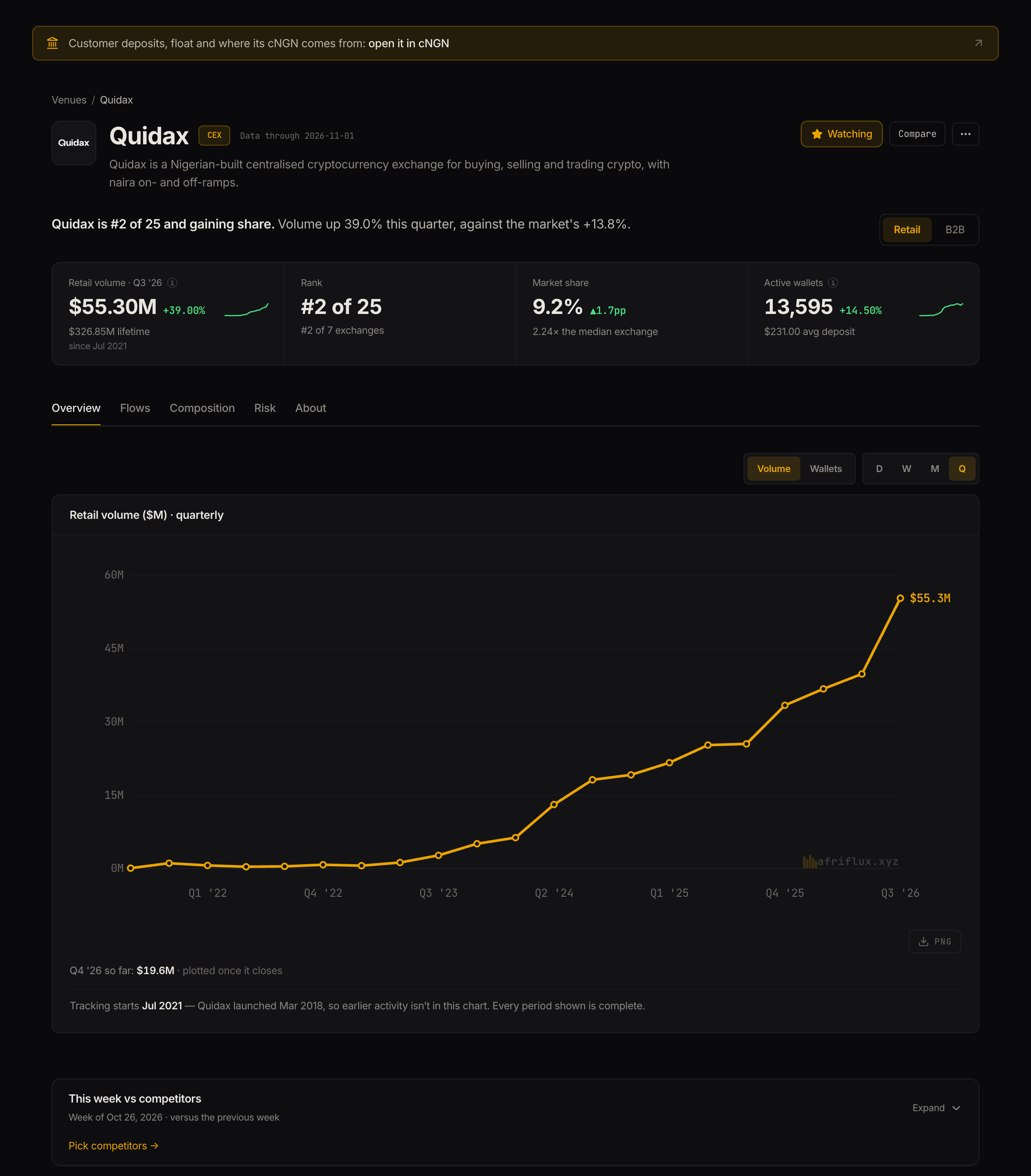
New venues show up here before they appear on the public site.
Tokenized assets
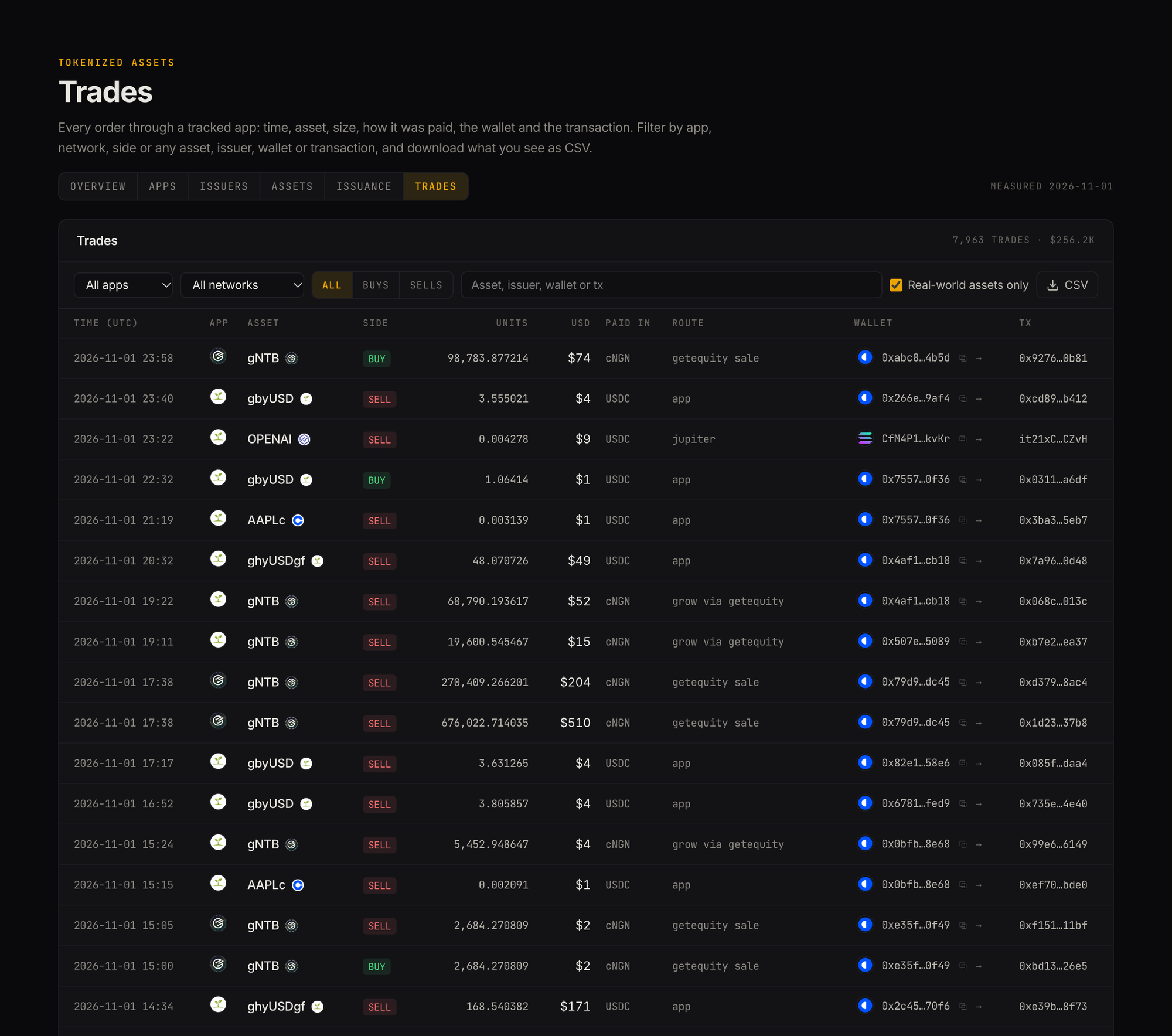
Stocks, ETFs, metals, pre-IPO shares and Nigerian listings bought onchain through African apps. You can look at it by app, issuer or asset, with a summary of this week at the top.
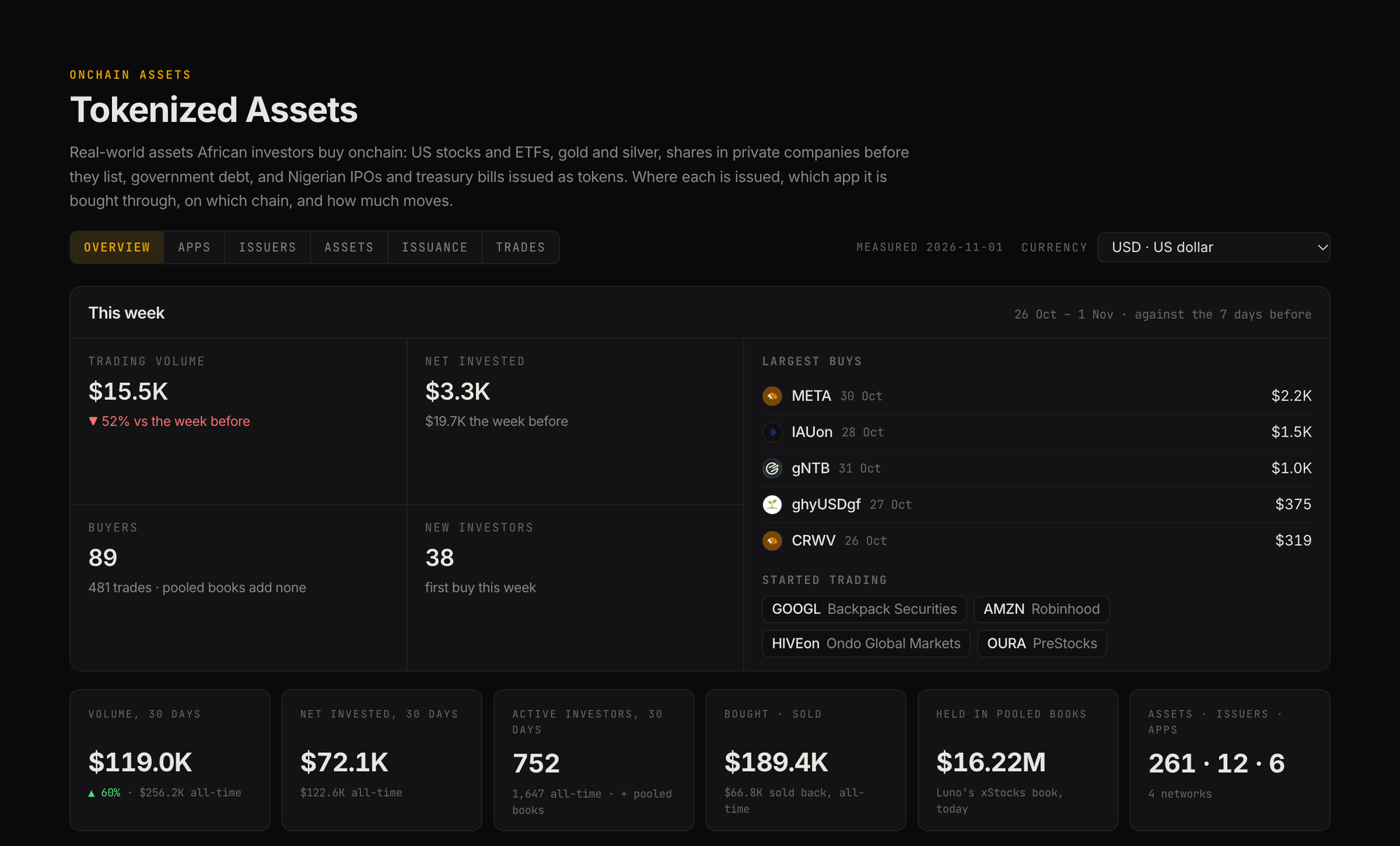
Public version: totals and the top 25 assets, with a padlock where the rest would be. The Terminal shows:
- the full screener of every asset, with contract addresses
- every trade, with its route and settlement token, as a CSV
- the wallets holding each asset on each app
- the addresses behind each app
- alerts on new listings, large buys and changes in how much an app holds
Reserves
What each venue holds in its own wallets and how much it sends to global exchanges.
Public version: venue totals, the tokens held, daily settlement by exchange, and net flow. The Terminal adds each venue's reserve wallets and its own exchange accounts, so you can check every figure yourself.
Scout
A screener. Filter every venue by country, category, growth, volume, rank and standing. From the results you can follow all of them in one click, compare them side by side, or save the filter.
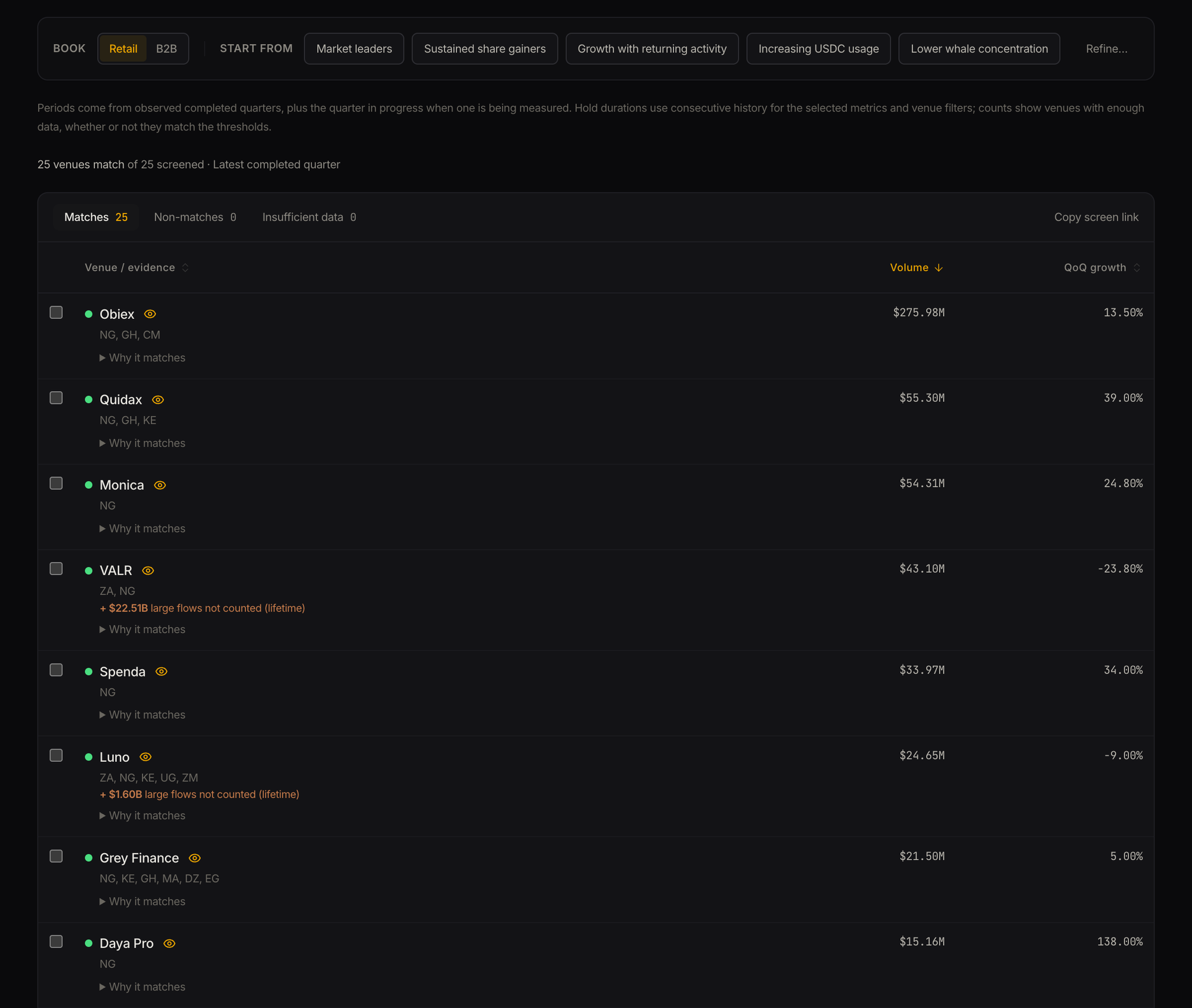
Public version: none. On the public site you browse the lists we have already sorted.
Compare
Any venues or categories side by side, on any metric we measure, by month or quarter, over their full history.
Public version: none. On the public site you look at one venue at a time.
Trail
Trail follows the wallets that send money into venues. That lets it show something no venue can see from its own books:
- what share of your depositors' money stays with you
- how much of it goes to each competitor
- how many of your depositors also use other venues
- which wallets left you or joined you this period
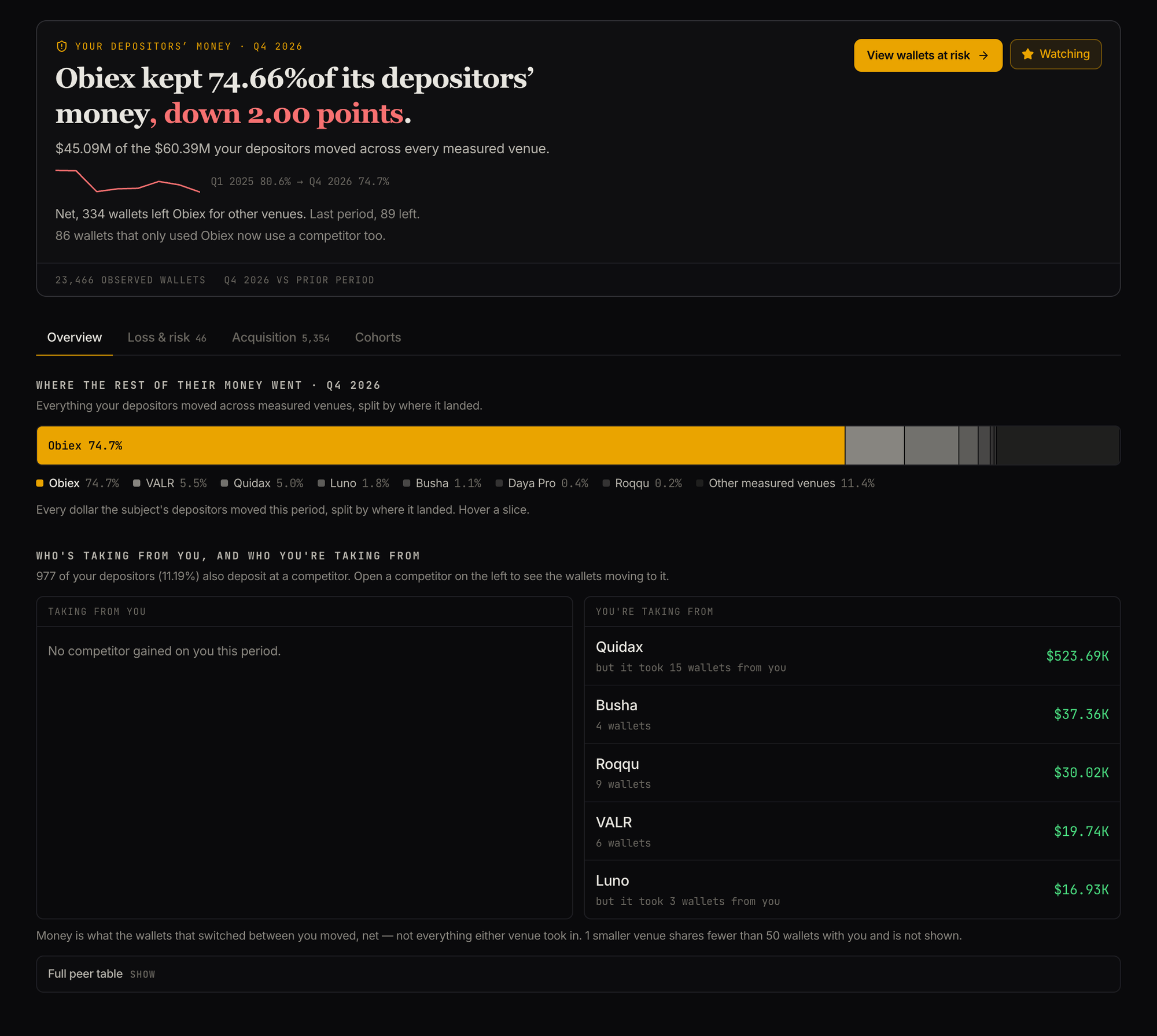
Public version: none.
Gradient
Our ratings: the Market Matrix, the AfriFlux Score, rating changes, the landscape view and the Activity Index. It gives you a second opinion on every venue, built only from what we measure onchain.
Public version: the Growth Index, our monthly ranking. Gradient shows the full detail behind each rating and the changes as they happen.
Freeze Watch
Paste any wallet address. Freeze Watch tells you whether Tether or Circle has frozen it and which venues it dealt with. A venue also sees the frozen addresses that touched its own wallets, the most serious first, with a file it can hand to its compliance team.

Compliance is built into the Terminal and runs on the same data as every other page. Freeze Watch looks at frozen addresses through the venues we track in Africa. If an address doesn't show up, it says "Not found at any venue we track." It never calls an address clean.
Public version: none.
Alerts and saved monitors
Follow a venue, app or token with one click, and its changes reach your Briefing and your inbox. You can write your own rules, such as "tell me when this venue's market share drops below 5%." You can also save a Scout filter so you hear about it when a new venue starts to match. All your rules live in one place.
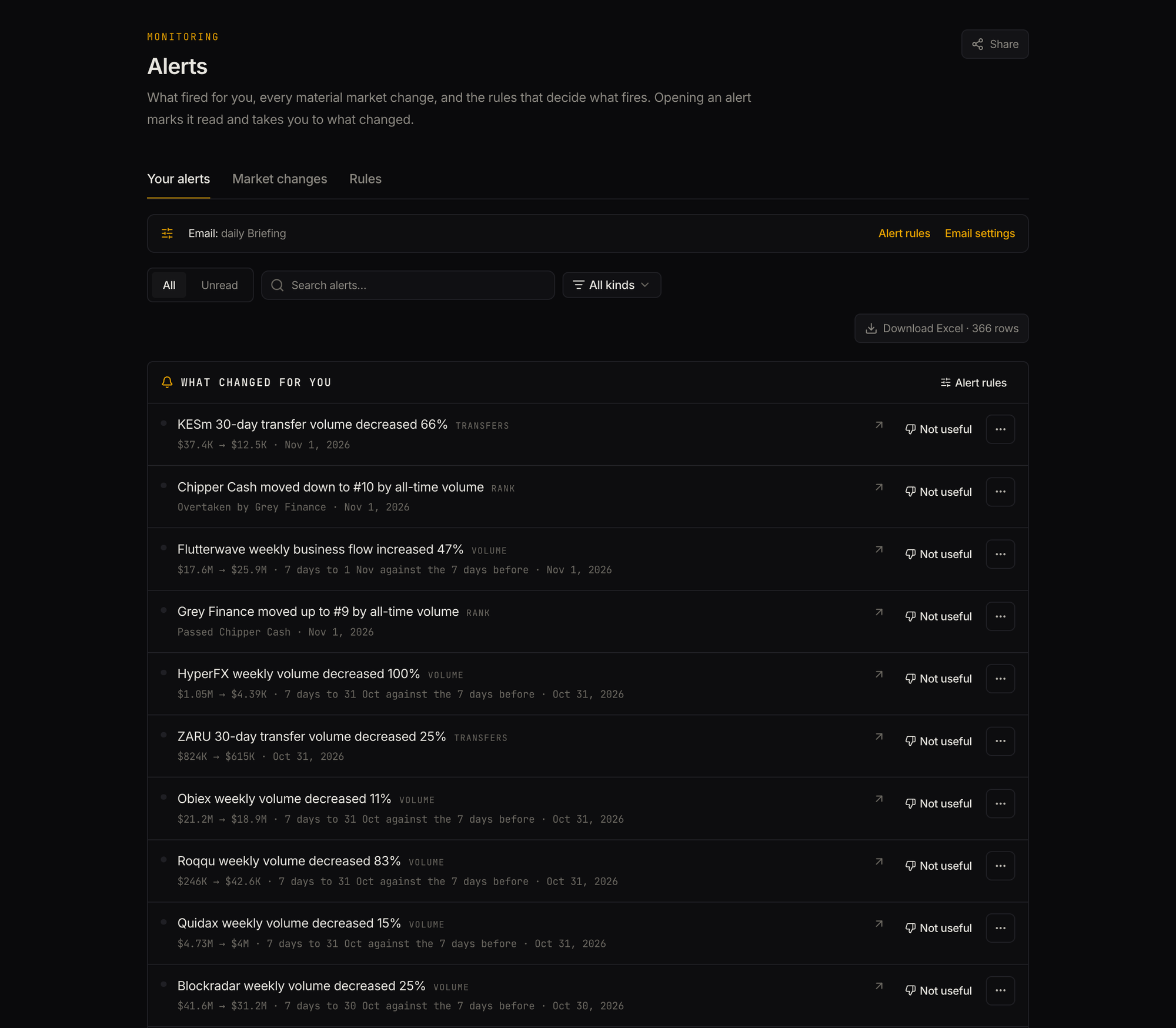
Public version: the newsletter. It is the same for every reader and comes on a fixed schedule.
What comes next
The Terminal follows the idea that made Bloomberg work: every page links to the others, one search bar takes you anywhere, and you can follow anything with one click. What it covers is African stablecoin money, measured onchain.
The next step is more venues. We cover 26 of 465. Each new venue gets a full dossier and shows up in Scout and the Briefing. It adds a competitor to Trail and more addresses to Freeze Watch, and it reaches the Terminal before the public site.
See it for yourself
If you want to see the Terminal on your own company's numbers, book a demo. We'll walk you through every page above, using your venue and the competitors you follow.